Mining update: fracking

Buru Energy is continuing exploration and development of the Canning Basin. They’re interested in further testing and exploring for gas at two sites—Yulleroo and Valhalla, where there are four existing wells.

The gas they’re keen to test is buried between 2-4km below the ground. It’s known as ‘unconventional gas’ because it’s locked tight within the rock. To get to it, Buru needs to use a process called fracking or hydraulic fracturing. Fracking could potentially pose a risk to Country and a risk to human health.

Here’s how it works: a mixture of water, sand and chemicals is pumped down into the well and shoots out through holes in the well wall and into the rock. The sand in the mixture causes tiny cracks in the rock and this is how the gas is unlocked and released.

One worry, is that although the fracking at Yulleroo and Valhalla will be 2-4km underground, the process might poison our drinking water, which is 20-500m from the surface.

Buru Energysay fracking is a safe process and that the technique has been perfected by operators and thoroughly assessed by independent scientists and analysts. They say the aquifer located under Buru Energy’s sites does not flow into Broome’s water supply, so there is no chance of contamination of the town’s drinking water.

The Environmental Protection Authority (EPA), wrote to Buru saying Buru do not need to have a formal environmental assessment as their tests are ‘unlikely to have a significant effect on the environment.’

APPEA says incidences of water contamination were not from fracking but from problems will wells such as minor leaks.

WA’s Water Corporation says there are potential risks to the public’s drinking water from fracking.

WA’s Government says the protection of water resources is it’s highest priority and all chemicals used in a well must be approved.

The National Toxics Network says the group of chemicals Buru will use in fracking are toxic, with some known to cause birth defects in animals.

The Australian Council of Learned Academies says there have been no cases internationally where fracking has accidently hit a water source and caused contamination.

The Conservation Council of WA says fracking has the potential to cause permanent damage to WA’s environment, ecosystems and natural and cultural heritage.

We believe there should be no fracking on our members’ Country without our consent. KRED are currently in the process of assembling an expert panel to offer independent advice on Buru’s suggested environmental modeling. While there is currently no fracking on our members’ Country, it is likely there will be in the future, and the data that Buru collects from these first tests at Yulleroo and Valhalla will form the baseline data for all other fracking experiments. Culturally, our Dreamtime stories connect underground water from Jaru right through to the west Kimberley coast. A large part of the west Kimberley is also on the National Heritage List, for its ‘rich and dynamic Aboriginal culture’, its ‘biological richness’, and its ‘geological and fossil evidence of Australia’s evolutionary history’. We want to ensure we have in place the most rigorous environmental assessment possible so our Country is protected. We act on the direction of our members: the Traditional Owners in the Kimberley.
Who's in our backyard?

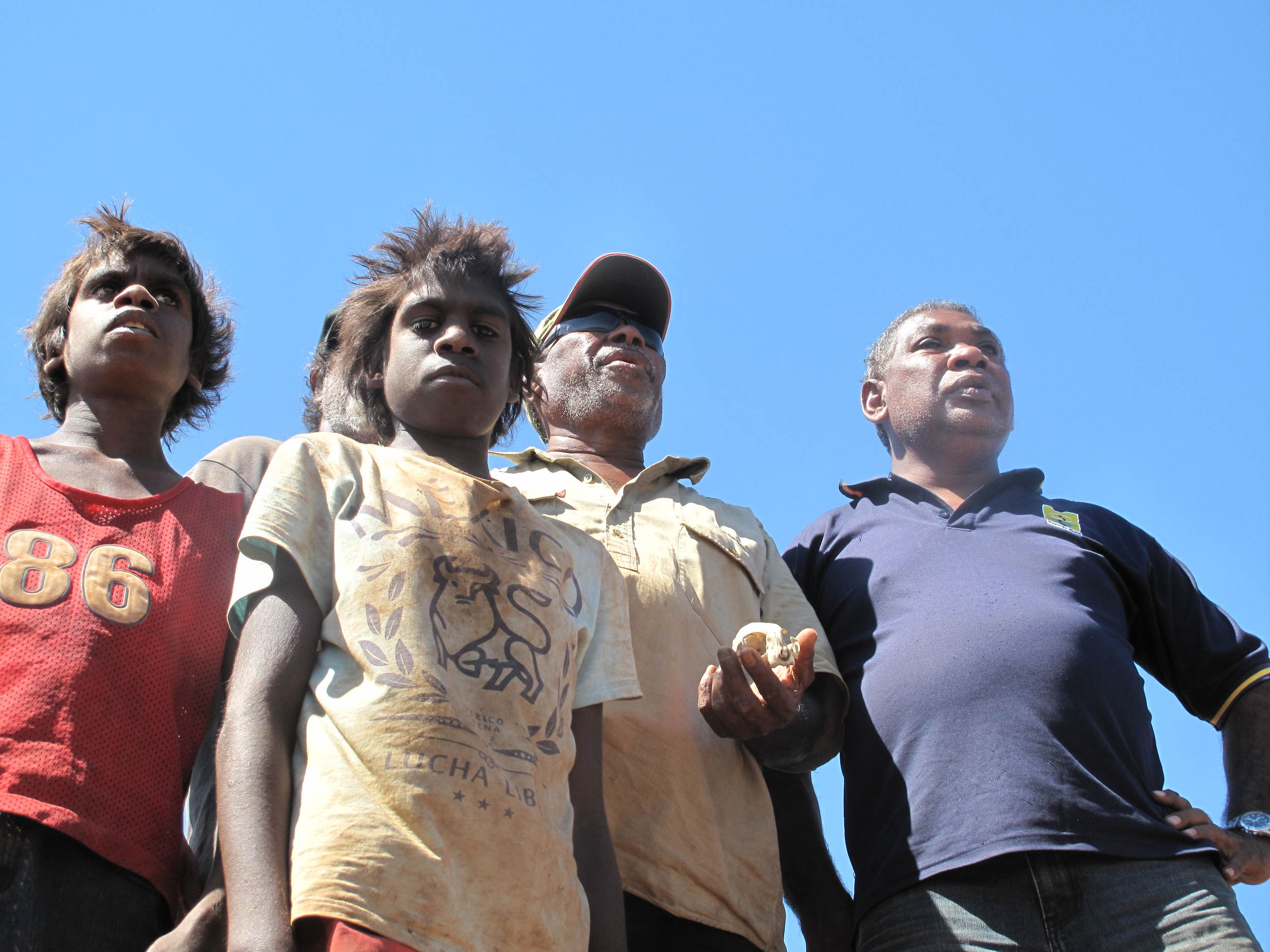
The development of the Canning Basin could mean millions of dollars for WA. The Superbasin extends under Broome, the Dampier Peninsula, Derby, Fitzroy Crossing and Yampi Sound training area and is estimated to hold up to 229 trillion cubic feet of gas and 10 billion barrels of oil. This means there’s a great opportunity for economic participation by our people—if you consider the jobs, apprenticeships and training opportunities it may provide—but at the same time, it also poses the biggest threat to our traditional lands.

We hope to support our members in making informed decisions about what happens on their Country and negotiate to ensure any development meets the highest possible cultural and environmental standards. For us, prosperity must be about three things: people and culture, country, and economy. KRED firmly believes companies should have a social license when involved in projects that affect people and Country. This means projects have the ongoing approval and acceptance of the community and Traditional Owners.

Some of the key companies involved in oil and gas exploration in the Canning Basin include:

Buru Energy/Mitsubishi are the biggest players. They’re a joint partnership and have exploration permits mainly in the northern part of the Canning Basin, covering Nyikina Mangala, Karajarri and Ngurrara Country. They own the Yulleroo gasfield, the Valhalla gasfield and the Ungani oilfield. They are supported by the WA government, howeverthe WA government has not sought KRED’s input into any agreement with Buru and Mitsubishi.

Rey Resources currently holds a coal exploration tenemant and has commercial interests in Buru’s tenemant. Their permits are on Nyikina Mangala Country.

New Standard Energy owns exploration permits mainly in the southern Canning Basin. They’re interested in oil, unconventional gas, and are partnered with ConocoPhillips and Chinese oil and gas giant PetroChina. Their permits cover Ngurrara, Yawinya and Karajarri Country.

Other companies with interests in the Canning include: Areva, a French multinational interested in uranium exploration on Nyikina Mangala Country; HESS, a US company which now has two permits in the Canning Basin; and Shell which has an acreage in the Offshore Canning basin in conjunction with Woodside.

Culture is the life-giving medicine

In State Parliament in February, Josie Farrer spoke of suicide creating a ‘wave of grief’ throughout her electorate. It is, in fact, a wave that rolls across electorates: across the Kimberley, across the Tiwi Islands, across the communities of Cape York, and back again.

A new report, ‘The Elders Report into Preventing Indigenous Self-harm and Suicide’, profiles the perspectives of Elders and community leaders from northern Australia and aims to answer the questions: why is self-harm and suicide still happening? And, what is the solution?

KRED Enterprises CEO Wayne Bergmann, says one of the reasons government strategies haven’t solved the problem is because they’re based on quick-fix models implemented by outsiders and are subject to the ebbs and flows of funding.

“Aboriginal people need to be involved in solving our own problems. Bringing outsiders into the Kimberley will not create succession, the legacies of change that we need . . . There are a lot of people running around trying to do good, but it doesn’t create intergenerational change. We want to up-skill our own people.”

It’s a sentiment shared by other leaders in the Kimberley, including Fitzroy Crossing’s Dean Gooda.

Mr Gooda says, “We have always heard of policy development from the ground up, but in my 25 years working in this area with government and community, I have never seen this happen. I have never seen them take and implement what the community is asking for if it doesn’t fit into the funding guidelines . . . It is frustrating, because we can see a light at the end of the tunnel.”

A number of leaders view this light as a reconnection to culture. Fitzroy Crossing elder Joe Brown says, “If they [young people] lose language and connection to culture they become a nobody inside and that’s enough to put anyone over the edge . . . We’re trying to bring them back, make them really strong.”

Many of the leaders agree that an effective way to do this is to take young people at risk back to country. The Yiriman Project, which kicked off in 2000, offers an on-country cultural program designed to heal through intergenerational knowledge sharing. Yiriman founder, John Watson, says young people often react strongly to the experience.

“Some come out clean, some of them understand what we’re talking about, some of them cry—it gets into them very deep.”

KRED’s Chairperson Anthony Watson is also a founder and Chairperson of the Yiriman Project. He acknowledges securing funding for the program is an ongoing challenge but says, “I’m dedicated toward the social and cultural programs in the community and helping youth bridge the gap.”

Professor Pat Dudgeon also acknowledges that culture is crucial for healing. She says, “Culture has become a life-giving medicine for our people, closing the wounds of the past and standing us strong to face the future.”

One of the biggest challenges for Indigenous young people is in learning to walk in two worlds, in finding a balance between earning a wage and maintaining traditional knowledge, values and cultural practices. The overwhelming consensus among leaders in this report suggests challenges such as this are best met not by fly-in-fly-out bureaucrats, or policy makers in Canberra, but by community leaders and Elders.

Mr Bergmann says, “That’s where the real answers lie, in empowering Aboriginal people to address community issues.”

What have homemade tattoos got to do with The Dog Act of 1883?

Gordon Marshall, a Karajarri man, remembers giving himself homemade tattoos as a twelve or thirteen year old. He shaved his arm and then used the burning sap-slimed seeds of the Willing tree to dissolve designs into his skin. It was a kind of toughness test, so despite the searing pain, there was no way he flinched.

This is one of the stories told as part of a joint Nyikina Mangala and Karajarri cultural awareness package and over the last month, KRED Enterprises has delivered a number of the packages.

Robert Watson, who’s also delivering the training, says the key aim is to foster appreciation by giving people a fair and accurate picture of Indigenous culture and history.

“We’ve had Prime Ministers pay homage time and again to Aboriginal people, we’ve even had a Prime Minister say sorry, but for many people, these are bare political statements. Our cultural awareness packages are about giving meaning to these statements. They’re about peeling back the dry layers of history to reveal a very real, a very human face.”

The joint package spans 50,000 years of Indigenous history, moving from the complexities of Karajarri kinship ties to the devastating legacy of the Stolen Generations; from basic bush medicine to The Dog Act of 1883.

Robert Watson says we can’t challenge the status quo, or even understand why the status quo exists today, unless we understand this history.

“Until we understand history, we are unable to put the journey of Aboriginal people into context; we are unable to appreciate the annihilation, dispossession, insecurity and marginalisation from policies and decision-making processes.”

Gordon Marshall says it’s important people working on Karajarri Country undergo the training.

“When people come out onto Country, they need to know about Country. They need to know about the places they can and can’t go. If they’re told not to go there, then no means no. This cultural awareness package gives them a better understanding of why this is important.”

The packages are a part of the work KRED does with companies to ensure any development on our members’ Country is designed and operated to meet the highest environmental and cultural standards. They are run through KRED’s wholly owned subsidiary company EHSIS and are part of KRED’s mission to create positive legacies for our members in the Kimberley.

While participants aren’t required to stick their arms out for a bush-tattoo, we are confident that the material in our packages will leave a positive mental tattoo: one that reminds us of the need for mutual respect and mutual understanding in all our personal and commercial relationships.

Waves of grief, waves of hope

Verbal brawls, a blatant disrespect of the Chairperson and very little in the way of robust, democratic and intelligent debate, characterised WA State Parliament on Thursday 20th February.

There was talk of private investment in resorts, golf courses, shopping centers and multi-story car parks; there was a mention of the quarterly CommSec report stating Western Australia ‘… remains the top-performing economy in the nation with no slippage in the ranking over the past few months.’

Then the Member for the Kimberley stood up, and the Parliament fell into a fidgeting silence.

The Hon. Josie Farrer gave notice to State Parliament that the State Constitution be amended to recognise Aboriginal people as the First Peoples of Western Australia.

“It is time—it is very definitely time—that we here in this Parliament, through our leadership, demonstrate that we are all equal in law, in humanity, in life and in death … I know this is not a timid step and I know there are people on both sides of this house who want to shy away from this because they will be afraid, but timidity has never achieved anything great,” she said.

“It will be a way to demonstrate to the rest of the nation that WA accepts and recognises that true reconciliation means bold action, brave people and meaningful dialogue.”

She commended the Premier’s commitment to introduce a bill recognising the Noongar people as the traditional owners of the south west of Western Australia, but reminded the parliament that not all Aboriginal people in this state are Noongar people.

“We may look the same to some of you mob, just like you white people look the same to us!”

There was laughter at this.

“(But) Seriously, what about our people? What about my mob, the Kija mob? What about the Nyikina, Yawuru, Karajarri, Ngurrura, Bunuba, Martu, Miriuwung Gajerrong or Ngaanyatjarraku peoples?”

Ms Farrer suggested the following words be added to the preamble amending theConstitution Act 1889:

‘And whereas the Houses of Parliament resolve to acknowledge the Aboriginal peoples as the First Peoples of Western Australia and traditional custodians of the land, the said Parliament seeks to effect a reconciliation with the Aboriginal peoples of Western Australia.’

Ms Farrer also touched on a number of crucial issues relevant to people living in the Kimberley.

She noted that while many constituents would have enjoyed a holiday over the Christmas break, this wasn’t the case for her. In the Kimberley over Christmas there were three suicides, including a 12-year-old boy in Halls Creek who hung himself.

“Suicide continues to create a wave of grief throughout my electorate,” she said.

Ms Farrer urged the Legislative Assembly to think about the bipartisan commitment given by members to the issue last year.

“What has happened since that time in communities to improve and support the mental health and well-being of people who need it?” She challenged. “Interagency collaboration and communication is still not fully utilised, and the current silo approach of departments is not effective. Procedures, especially for data collection methods, are not consistent and shared between departments that have a vested interest in the same situation—namely, police, Department for Child Protection and Family Support, youth justice, education and mental health.”

Ms Farrer then went on to ask why, in this state, with the top performing economy in the country, there are people living in third world conditions, children who miss out on weeks of education because the roads into communities are cut off by flooding, whole families crammed into homes with leaking sewage, exposed electrical wires and structural problems. She asked why the Indigenous housing package was delayed for two years, and now won’t be rolled out until 2015.

As Ms Farrer’s speech indicates, the reality on the ground in the Kimberley is quite different to the abstract reality of affluence and growth intimated by the recent CommSec report.

With this in mind, there continues to be a pressing need for the kind of work KRED Enterprises does in supporting local Aboriginal people to be active participants in the economy and to secure long-term economic independence for Aboriginal people in the region. By standing together we’re strong, and we have a real chance to make positive changes to address some of the issues Ms Farrer raised in parliament last Thursday.

But change needs to happen on a political level, as well as a community level.

KRED Enterprises and the Ambooriny Burru Foundation applaud Ms Farrer for beginning the push for a change to WA’s State Constitution. It’s well and truly overdue. We look forward to the day Aboriginal people are officially recognised as the traditional custodians of this land.