‘China backing pastoral vision’

The following article was written by Paige Taylor and was reported in The Australian newspaper today on the 26/05/2014. 
See: http://www.theaustralian.com.au/business/china-backing-pastoral-vision/story-e6frg8zx-1226931107552
Bohemia Downs station manager Alan Lawford. Picture Colin Murty. Source: NewsCorp Australia. 

TEN of Australia’s biggest Aboriginal-run pastoral stations are preparing for a Chinese-backed merger that aims to reverse their economic fortunes using world-class breeding, management and feed-crop technology.

The Aboriginal Pastoral Co-op will begin as a commercial consortium of five cattle stations in the Kimberley that have struggled in isolation to achieve good prices.

Though debt-free, the stations in the first phase of the proposed co-op have never turned big ­profits and are too small on their own to leverage good economies of scale or manage supply chain costs.

Elders in the region are disappointed the stations many of them grew up on do not have the ability to employ larger numbers of young Aboriginal people.

The consortium could have up to $40 million of Chinese investment through investment house ASF Group. The firm’s director, Geoff Baker, said the ASF Group had access to finance in mainland China, Hong Kong and other parts of Asia that could help the co-op get the most from its cattle stations.

“The Chinese believe Australia is awash with resources, agricultural products and cattle — it doesn’t take much convincing of those opportunities,” he said.

He said the ASF Group had a healthy relationship with traditional owners, many of whom have Native Title over land in the region as well as strong connections to pastoral stations.

“We want to have a good relationship with traditional owners,” Mr Baker said.

ASF Group saw “enormous potential” in the co-op concept, not least because the Kimberley was a lot closer to Asia than states such as Victoria and NSW.

ASF Group, which is already active in the Kimberley with exploration projects, is in talks with the Aboriginal Charitable Trust putting the consortium together, KRED Enterprises.

Under the long-term plan, ASF Group’s investment could help create infrastructure and irrigation systems to support 16,000 head of cattle in a Kimberley corridor. Ultimately mustering costs would be reduced by 25 per cent, according to a co-op concept plan.

The consortium would market its own brand of organic Kimberley rangeland beef for export to China. The concept for the consortium has the support of Agriculture Minister Barnaby Joyce.

The Abbott government has honoured a commitment by the Rudd government to contribute $400,000 towards the setting up of the consortium in the form of a grant to KRED.

Bohemia Station manager Alan “Doodie” Lawford said he wanted to help reinvigorate the industry because that would mean more jobs on the land for young Aborigines.

“Our young people want to be out here,” he said.

Indigenous Business Australia is preparing the business and marketing plans for the co-op.

So far, 10 cattle stations have asked to join. If the consortium ­begins well, more members would be welcome, including cattle ­stations in other regions and states, and those owned by non-Aboriginal interests.

KRED chief executive Wayne Bergmann said Aboriginal-run pastoral stations had suffered the same setbacks over the years as the ones felt industry-wide, ­including the crippling effects of Labor’s live export suspension.

Costs have spiralled, but the price per head has been virtually unchanged for 18 years.

Mr Bergmann said he believed there were extraordinary opportunities for a co-op with strong management. The consortium was dreaming big.

“I see it like the early days of Wesfarmers, where farmers got together collectively and had a management team to deal with challenges nationally,” he said.

The above article was written by Paige Taylor and was reported in The Australian newspaper today on the 26/05/2014. 
See: http://www.theaustralian.com.au/business/china-backing-pastoral-vision/story-e6frg8zx-1226931107552
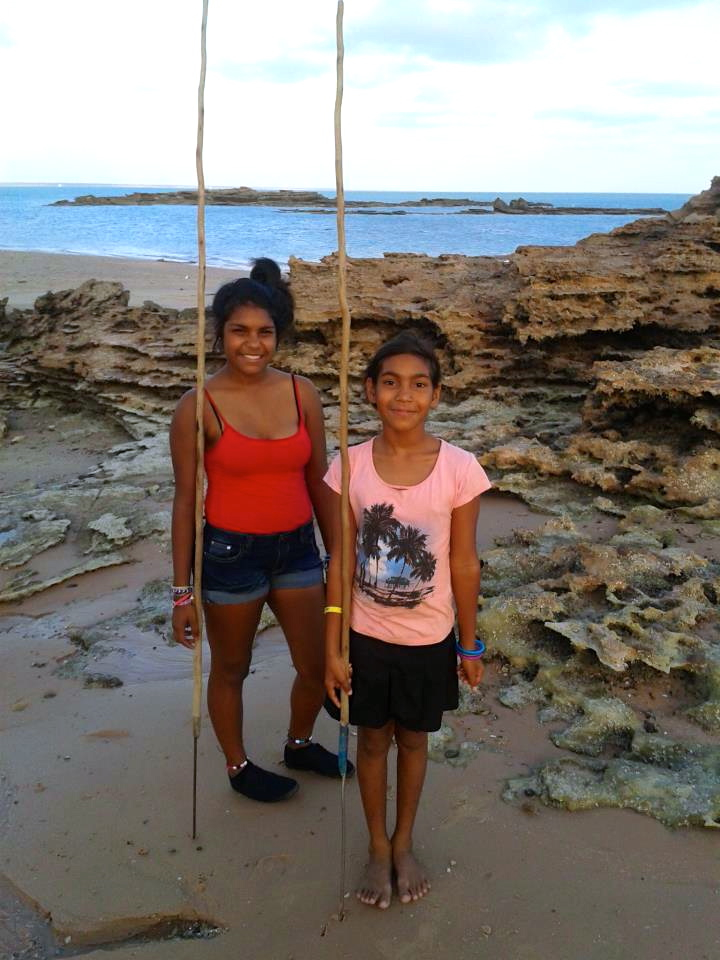
Give it all you got!

From the moment they hit the stage, guitars straps slung over shoulders, twelve year-old Adi and fifteen year-old Jada communicate without words. It’s incredible to watch—this subtle movement of hands and eyes, a chord here, a note there.

“We give each other secret signals, play a little bit and then we know where to start,” Jada says.

The Broome-based sisters have their own band ‘Jadadi’ and with the support of an Ambooriny Burru Nipper Tabagee Scholarship they were able to travel to the Tamworth Country Music Festival earlier this year.

In Tamworth they played back-to-back gigs, brushing shoulders and even breakfasting with country music heavyweights like Troy Cassar-Daley and Casey Chambers.

Pumped up on energy drinks, they played on stages and busked on the street. “When we were busking, a lot of people gathered around and afterwards, the crowd took photos with us and we got to sign autographs,” Jada says.

The stack of cds they took to the festival sold out within days.

“We were supposed to save some for our family back here, but people kept buying them!” Jada says.

It’s easy to understand why. The girls complement each other, blending seamless harmonies as they sing about fishing, about love, about home.

“Sometimes we do get nervous before we start playing,” Adi admits, “but we’re grateful to have had the opportunity to go to Tamworth and build our confidence.”

Jada agrees, saying the Nipper Tabagee Scholarship really gave the girls the lift they needed.

“It made it possible for us to play at the festival and to give us exposure at this national level.”

The Nipper Tabagee Scholarship is designed to help end the disparity in employment outcomes between Aboriginal and non-Aboriginal people.

By encouraging our young people to pursue and achieve their goals in the short-term, we’re also securing their long-term economic and social engagement.

We believe supporting the aspirations of our people will prove to be one of our greatest investments.

When asked what advice they’d give other aspiring musicians Jadadi says, “Give it all you got! Make yourself heard. Because there’s people out there that can help you.”

For more information on the Nipper Tabagee Scholarship contact KRED Enterprises on 91 92 8782.

ICRG delivering real employment outcomes for our mob

KRED Enterprises is proud of its joint venture with the Indigenous Construction Resource Group (ICRG). ICRG have delivered 100% Aboriginal employment on construction at Valhalla and an average of 75% Aboriginal employment on all other contracting jobs with Buru Energy. Employees, many from Noonkanbah and Derby, have been involved as civil works operators, in site preparation and have worked on bunding around dams. ICRG have been a fantastic mob to work with and we look forward to an ongoing positive relationship in the future.

KRED lobbying for global benchmarks at United Nations

KRED Enterprises CEO Wayne Bergmann and CEO of the Kimberley Land Council Nolan Hunter are set to jet to New York to speak at the United Nations Permanent Forum on Indigenous Issues.

In a joint presentation, they’ll lobby for a set of global best practice principals and benchmarks for Indigenous economic development.

Mr Bergmann told ABC Kimberley (29/04/14) that companies can broker different – and potentially less beneficial – commercial deals and agreements with Indigenous people, depending on which country they’re operating in.

“I’m hoping to reinforce an international alliance on benchmarking where we can really talk best practice … In situations where we can’t stop development, we need to make sure it’s done on the best possible terms.”

Through all commercial negotiations, KRED Enterprises references a triple bottom line of people and culture, country and the economy.

With this as a foundation, KRED’s negotiated some of the strongest impact benefit agreements between mining companies and Indigenous people in Australia. Often these agreements go beyond the statutory agreements of governments and ensure any development is designed to meet the highest environmental and cultural standards.

Mr Bergmann says in Australia, Aboriginal people are regularly put in a difficult position.

“We have a resource rich country with an appalling history of mistreatment of Aboriginal people. This puts Aboriginal people in a difficult position. We have a responsibility to look after country, but it’s also crucial we participate in the modern economy.”

Mr Hunter elaborated, telling ABC Kimberley that engagement with companies often provides an uncomfortable tension for Indigenous people.

“The tension (is) between how you engage with economic development without compromising your cultural integrity.”

Mr Bergmann says the solution lies in creating economic opportunities that affirm Aboriginal cultural and social values.

“We want the choice to be able to practice the culture and values of our ancestors and to walk on Wall Street, as part of the mainstream economy,” Mr Bergmann says.

Mr Bergmann and Mr Hunter leave for New York on the 9th of May.

Keep your eyes on our Facebook, LinkedIn, Twitter and Instagram accounts for updates, as we’ll be sharing selfies, conference snaps and speech excerpts.

For more information on the trip, contact Media and Communications Officer Madelaine Dickie at KRED Enterprises (08) 91928782.

KRED donates to keep children’s bellies full

Cooking for 3 kids is generally okay—you might even have a bit left over for lunch the next day. Cooking for 13 kids is starting to get tricky—will you have enough for everyone? Now imagine what it must be like cooking for 300 kids …

Broome-based organisation Feed the Little Children are doing just this. In the space of only two years they’ve gone from preparing 15-20 meals a week, to preparing 300 meals twice a week for children and young people who’d otherwise be going hungry.

The motivation behind Feed the Little Children’s work is that if children have a full belly, they’re less likely to commit crime. Feed the Little Children’s CEO Clint Durham says there’s evidence to suggest many young delinquents commit their first crime because they’re hungry.

“If you don’t have food or glucose then you don’t think properly. You get cranky and you do silly things. Although the program hasn’t been running for long—and although I might be a bit biased— I’ve definitely seen a change in a number of families I’ve been to. The kids look healthier, mum’s not as stressed out and the increased levels of nutrition will help the kids fight things like ear, nose and throat infections,” Mr Durham says.

KRED Enterprises understands that our young people can’t reach their full potential on an empty belly. Our young people have no chance of going on to further study at university, or of becoming active and engaged participants in our communities and economy, if they’re too hungry to pay attention at primary and high school.

We also understand that breaking cycles of poverty and neglect is a community effort—not just one that should be left to the police, or to the schools. It’s about standing together and working together, because collectively we’re more powerful, collectively we have the ability to create real and positive change.

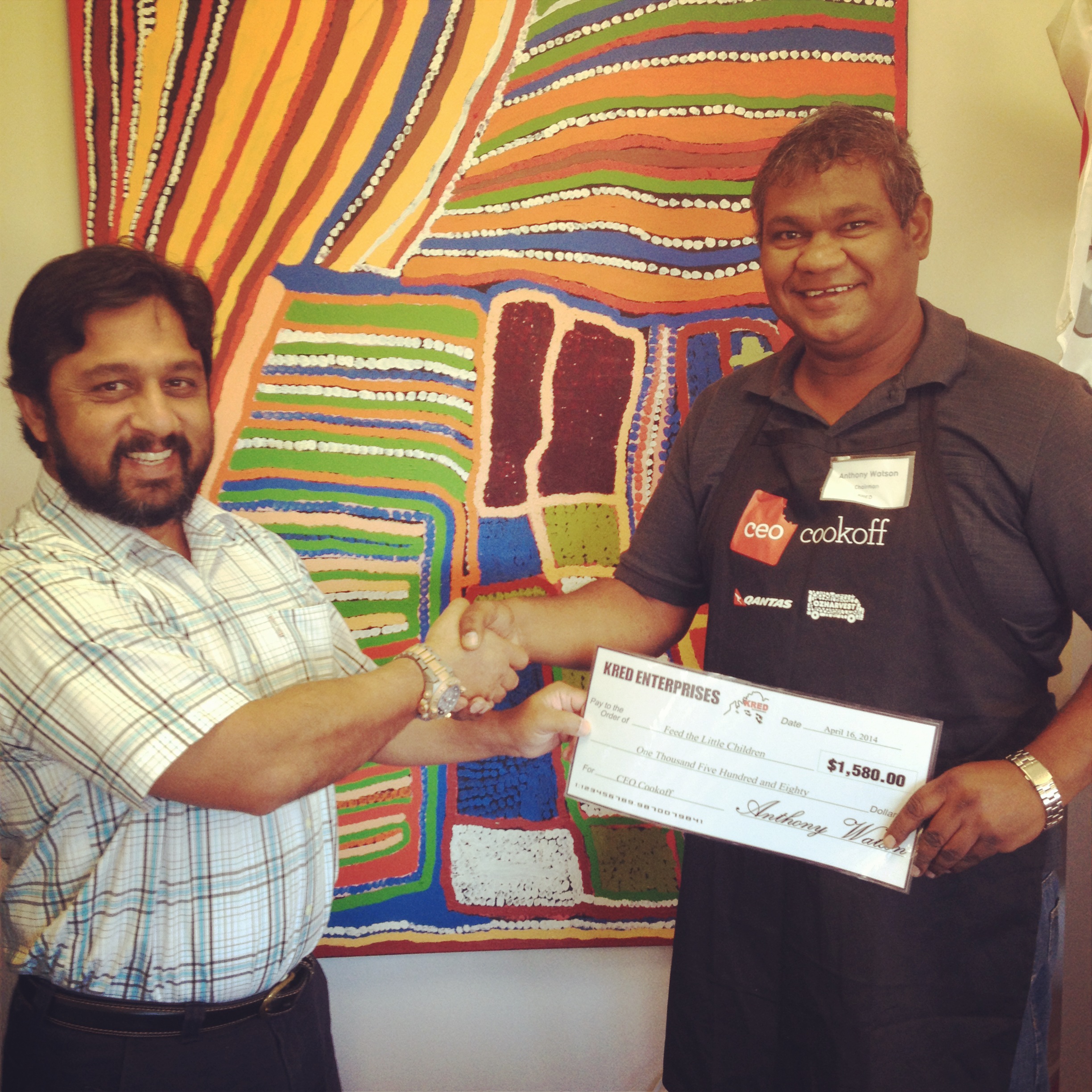
This morning, KRED Enterprises handed over a cheque for $1,580, making good on our promise to match dollar for dollar donations received by Anthony Watson for the OzHarvest/Qantas CEO Cookoff back in March.

Anthony Watson, as Chairperson of KRED and Chairperson and founder of the Yirriman Project, is adamant that community organisations like Feed the Little Children receive continued community, government and corporate support to ensure their longevity.

“We see programs come and then disappear when the funding is cut. We would like to see more community-run organisations, tailored particularly to our community needs, receive the support they need to keep helping our young people.”

It’s an issue close to Anthony’s heart, particularly with the future of the Yirriman Project uncertain. Although the men’s program will continue in 2015, funding for the women’s program is yet to be secured.

If you would like to find out more information, either about KRED’s support for Feed the Little Children through the OzHarvest/Qantas CEO Cookoff, or would like to speak with Anthony about the Yiriman Project, please call KRED Enterprises on 91928782.